
A broad route for conventional pipe materials and larger industrial applications where overall form and service conditions lead the selection.
Zhongtong Dingxing / seamless steel service
Select Seamless Steel Pipe by Process, Material and Service
For custom seamless steel pipe programs, the first decision is rarely just the name of the tube. A seamless carbon steel pipe review should connect no-weld construction with material family, wall thickness, pressure conditions and the industrial service where the pipe will be installed.
0.3-650mmDiameter range described.
No weld seamContinuous formed structure.
4 familiesCarbon, low-alloy, alloy and stainless.
Pressure serviceFluid, boiler and industrial routes.
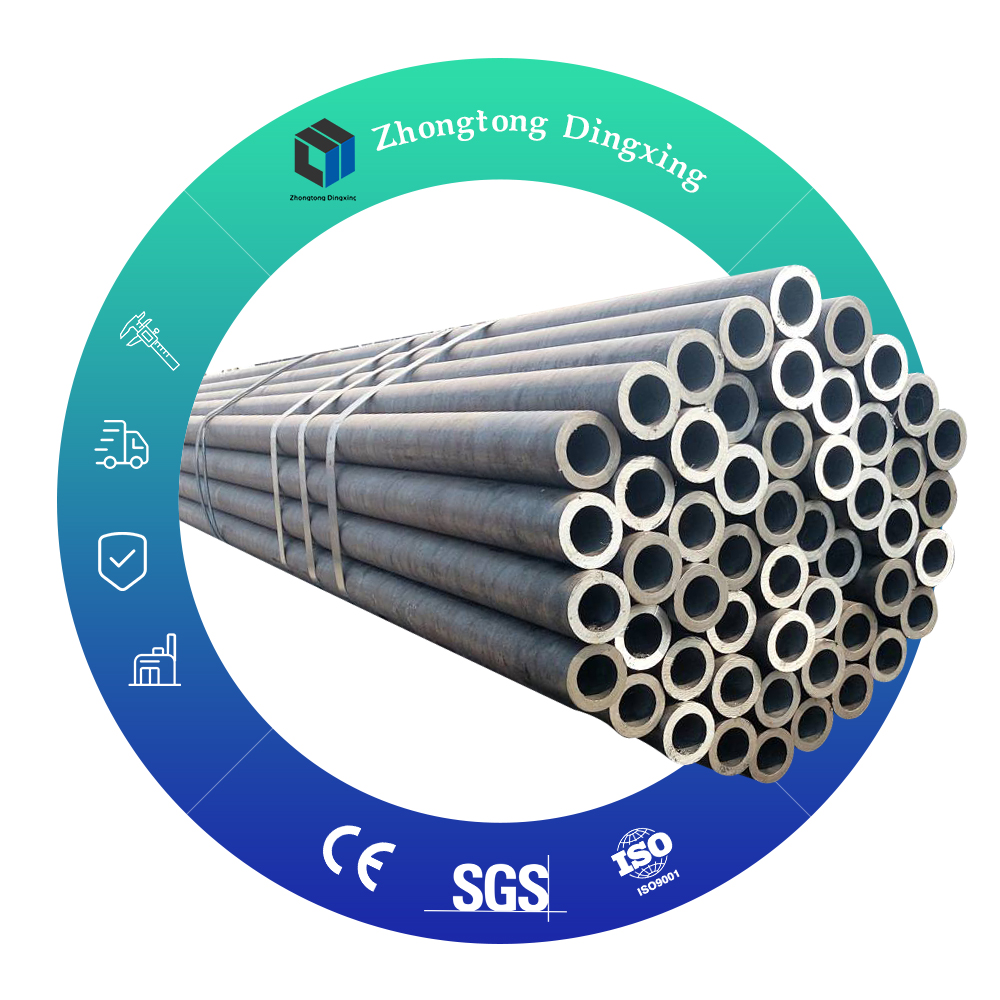
The continuous tube view helps review shape, surface and scale before discussing specifications.
Service selection facts
Keep the inquiry tied to process and operating conditions
A useful steel-pipe inquiry connects the production route with material family, dimensions, pressure, temperature, corrosion and application.
| Forming route | Solid round billet processed through hot rolling, cold rolling or cold drawing, with no splicing or welding along the tube. |
|---|---|
| Material families | Carbon steel, low-alloy steel, alloy steel and stainless steel. |
| Wall thickness | Thin-walled and thick-walled seamless pipe categories. |
| Diameter range | 0.3mm to 650mm described across precision components and larger industrial equipment. |
| Service routes | Structural supports, water/oil/gas fluid transport, boilers, heat exchangers, oilfield and petrochemical service. |
| Performance questions | Pressure sealing, temperature exposure, corrosion conditions, dimensional accuracy and surface finish. |
Process-to-application map
Match the production route to the service question
The right route depends on what the pipe must carry, support or withstand, not only on whether the order uses the word pipe or tube.
Discuss when smaller diameter, thinner wall, dimensional accuracy or surface finish are central to the assembly.
Use the route discussion for precision tube needs where controlled dimensions and smooth finish matter to mechanical integration.
Service selection matrix
Turn material and environment into a quote-ready brief
The same seamless construction can serve different industrial paths. The brief should make the operating boundary explicit before a grade or finish is proposed.
State carbon, low-alloy, alloy or stainless steel according to temperature, corrosion and mechanical requirements.
Provide thin/thick-wall preference, target diameter and length instead of relying on a broad category name.
Clarify whether the pipe supports a structure, carries water/oil/gas or enters a boiler and heat-exchange system.
Ask about dimensional accuracy, surface finish, non-destructive testing, pressure expectations and documentation.
Related steel products
Compare adjacent seamless formats by service role
These same-site products help separate boiler/oil applications, standard seamless tube specifications and stainless corrosion-service discussions.

API carbon steel seamless pipe
Boiler, oil and structural-service product with carbon-steel and API wording.
Open API seamless pipe
Standard seamless steel tubes
Tube format with ST33, Q355, SCH40, API and JIS specification language.
Open standard tubes
Seamless stainless pipe
Stainless format for uniform strength and corrosion-resistance conversations.
Open stainless pipeIndustrial reading
Three notes for seamless pipe decisions
These articles help clarify naming, pressure-line applications and corrosion-protection questions around custom seamless pipe.
Pipe or tube wording
Align the product name with the buyer's specification and the actual service conversation.
Read naming notePressure-line service
Frame oil, gas and hydraulic questions around pressure, dimensions and application conditions.
Read pressure-line noteCorrosion planning
Prepare environment and protection questions before discussing a custom industrial pipe program.
Read corrosion notePlanning questions
Seamless steel pipe FAQ
What makes a seamless steel pipe different from a welded pipe?
The seamless pipe is formed from a solid round billet without a welding seam through its length, creating a continuous metal structure.
Which material families are named for seamless steel pipes?
The named material families are carbon steel, low-alloy steel, alloy steel and stainless steel.
What diameter range is described?
The described diameter range runs from 0.3mm to 650mm.
Which applications are associated with the product?
Applications include mechanical structures, water/oil/gas fluid transport, boilers, heat-exchange equipment, oilfield work and petrochemical service.
What process routes should buyers discuss?
Discuss hot rolling, cold rolling or cold drawing according to the required diameter, wall thickness, dimensional accuracy and surface finish.
What should be included in a custom pipe inquiry?
Include material family, application, diameter, wall thickness, length, temperature or corrosion conditions, standard requirements and testing questions.
